The Zambia Ministry of Health and its partners through a consultative and collaborative effort of different expertise that included instructional designers, subject matter experts and eLearning technologists developed several eLearning courses with funding from USAID through the Maternal and Child Survival Program (MCSP).
COURSE MODULES
Introduction
In this study session you will learn about the status of maternal and newborn mortality worldwide, in Africa as a whole, and in Ethiopia specifically, so you can understand the extent of the problems that need to be addressed through improved maternal and newborn health services. Antenatal care, the professional healthcare a woman receives throughout her pregnancy, is important in helping to ensure that women and newborn babies survive pregnancy and childbirth. We show you how to plan the antenatal care services that your community needs in order to improve and protect the health of mothers and newborns during pregnancy, childbirth and the postnatal period. You will learn what is meant by the antenatal profile of your community, and how to calculate the number of mothers who are pregnant every year in your catchment area. They will need antenatal care throughout pregnancy, and your expert support during labour, delivery and the postnatal period. You will also be collecting and reporting data on how many antenatal visits each woman receives, and what proportion of births were attended by a health professional.
In this study session you will learn the difference between health promotion, health education, health screening and disease prevention, and learn about different methods of communicating health education messages respectfully and compassionately.
You will also learn how to educate and engage individuals, groups, opinion leaders and community members in the promotion and better utilisation of antenatal care services. Exactly the same principles apply to promoting the uptake of health services for labour and delivery, and postnatal care — as you will see in the next two Modules. Finally, we show you the steps in planning health education activities aimed at reducing maternal and newborn mortality by increasing the antenatal care coverage rate. You can apply these same steps to health promotion activities with other aims, for example increasing the uptake of family planning services.
Study Session 3 Anatomy and Physiology of the Female Reproductive System
Introduction
Applied anatomy and physiology for basic obstetric care is an entry to your studies in this Module and the next four Modules, and is essential preparation for your practical skills training. Obstetric care refers to healthcare for women during pregnancy, labour and delivery, and their immediate postnatal care. It requires a good understanding of the anatomy and physiology of the female reproductive system. Anatomy is the study of the structures of the human body, i.e. the features of how the organs, tissues and body systems are constructed. Physiology, on the other hand, is the study of the coordinated functions of the organs, tissues and systems in the body.
In this study session, you will learn about the structures that make the external female genitalia and the internal reproductive organs. In Session 4, we teach you about the hormonal regulation of the internal female reproductive organs and the female monthly menstrual cycle (bleeding from the vagina). In Study Session 5, we describe ovulation, fertilisation and implantation of the embryo in the mother’s uterus (womb), and the development of the fetus, the placenta and fetal nutrition. In Study Session 6, you will learn the anatomy of the female bony pelvis, and also of the fetal skull, which has to pass through the mother’s pelvis during delivery
In the previous study session you learned about the anatomy and physiology of the female reproductive system. The hormones oestrogen and progesterone were briefly introduced. In this study session you will learn much more about the role of these and other important hormones involved in the regulation of the human menstrual cycle, the monthly production of mature ova (eggs) by females of reproductive age, and the preparation of the uterus as a welcoming environment for the start of a pregnancy.
The exact moment when a fertilised ovum, embryo, fetus or baby is called a ‘human being’ is controversial, and differs between individuals, religious groups, legal systems and nations. We will not address this difficult concept in this study session, but focus instead on the theoretical knowledge of how fertilisation and implantation of the ovum in the uterus occurs, and how the fetus is nourished as it develops during the nine months of gestation. This study session will also help you to recognise factors affecting fetal development that may lead to complications during the antenatal period.
In this study session you will learn about the bony structures with the most importance for the pregnant woman and the baby she will give birth to. The bones of the skeleton have the main function of supporting our body weight and acting as attachment points for our muscles. The focus in this study session will be on the female pelvis, which supports the major load of the pregnant uterus, and the fetal skull, which has to pass through the woman’s pelvis when she gives birth.
There are certain key landmarks in the anatomy of the female pelvis and the fetal skull that we will show you in this study session. Knowing these landmarks will enable you to estimate the progress of labour, by identifying changes in their relative positions as the baby passes down the birth canal. You will learn how to do this in the next Module in this curriculum, which is on Labour and Delivery Care.
During pregnancy, a woman’s body changes in many ways due to the effect of hormones. These changes can sometimes be uncomfortable, but most of the time they are normal and enable her to nourish and protect the fetus, prepare her body for labour, and develop her breasts for the production of milk.
Can you recall the definition of a hormone from Study Session 3?
Hormones are signalling chemicals produced in the body, which circulate in the blood. Different hormones control or regulate the activity of different cells or organs.
In this study session, you will learn about some of the changes that occur during pregnancy in the uterus, cervix and vagina, the cardiovascular system, gastrointestinal system, and urinary system, and about changes in the breasts and skin. You will also learn about the implications of all these changes for you as a health worker managing the health of pregnant women. By understanding the normal changes of pregnancy, you can reassure the woman if she is concerned, and also detect and intervene more quickly if you notice any abnormalities. A basic knowledge of these changes and adaptations is also critical for understanding the results of laboratory tests that may be conducted at a health facility during the pregnancy.
This study session begins by providing you with the knowledge to diagnose when a woman is pregnant. You will learn to distinguish between the possible, the probable, and the positive (or sure) signs and symptoms of pregnancy. A symptom is an indication of a condition (such as pregnancy), or a disease or disorder, that is noticed by the affected person and which they can tell you about either spontaneously, or if you ask the right questions. By contrast, a sign is an indication that only a trained health professional would notice, or be able to detect by conducting a test.
To give good care to a pregnant woman, you also need to find out about her general health and any past pregnancies and births she may have had, and what this pregnancy has been like so far. These details are called a health history. The process of gathering all the information and recording it using clear, accessible questions is called history taking. In this study session you will learn how to ask focused questions about a pregnant woman’s health history. This knowledge will help you give correct and individualised advice to make this pregnancy and birth as safe as possible. You will also recognise the importance of maintaining the woman’s trust by keeping what she says to you confidential.
This study session shows you how to conduct a general assessment of the pregnant woman’s health status during an antenatal visit. You should make all of these assessments every time you see her for antenatal care. For each assessment, we first describe the signs and symptoms that indicate the pregnant woman is in good health. Then we describe the warning signs and symptoms that may indicate health problems that may lead to a serious complication of pregnancy, including anaemia, diabetes, poor nutrition, iodine deficiency, hypertension, fever, infection, lung and kidney problems.
Later in this module, you will learn about the most serious complications of pregnancy in more detail — HIV infection in Study Session 16; premature rupture of the fetal membranes in Study Session 17; anaemia, malaria and urinary tract infections in Study Session 18; hypertension, pre-eclampsia and eclampsia in Study Session 19; and bleeding in early and late pregnancy in Study Sessions 20 and 21.
In this study session, you will learn how to carry out an important measurement that should be done at every antenatal visit — measuring the height of the top of the mother’s uterus as a way of assessing whether her baby is growing normally. We teach you two ways of doing this — using your fingers, and using a soft measuring tape. This will enable you to estimate the stage of pregnancy she has reached, and check the accuracy of the due date calculated from the mother’s last normal menstrual period. Then we discuss possible reasons for the uterus growing too quickly or too slowly, and what actions you should take if you suspect that something may be wrong.
In this study session, we turn our attention to the physical examination of the mother in order to find out about the position and health of her baby. You will learn how to examine the mother’s abdomen in order to determine whether the fetus is lying head up, head down, or sideways in her uterus. Listening to the fetal heartbeat can also give you information about the baby’s position and its wellbeing. At the end of the study session we guide you about what to do if you suspect that the baby’s position may lead to a difficult or dangerous birth, or if you suspect the woman may be having twins.
During pregnancy, a woman’s body changes in many ways — as you learned in Study Session 7. These changes can sometimes be uncomfortable, but most of the time they are normal. They can occur at any time during the pregnancy. In this study session, you will learn about some of the most common minor disorders of pregnancy, and discuss ways to help women feel better, or at least to stop worrying about them. We will also explain how to tell when a woman’s discomfort may be a sign that there could be a problem that requires further investigation and management, or even that something dangerous is happening with her pregnancy. Most of the minor disorders during pregnancy can be minimised with good education and prompt treatment. You should also know about some remedies that are dangerous for pregnant women and may hurt the baby.
In Part 1 of the Antenatal Care Module, you have learned mainly about how the human reproductive system is structured anatomically and how it functions, the normal process and adaptation of pregnancy, the general assessment of the progress of pregnancy, and how to identify minor disorders. In Part 2 of the Antenatal Care Module, you will first learn about the basic principles of focused antenatal care (FANC).
This session will start by describing the concepts and principles of FANC and the basic differences between FANC and the traditional approach to antenatal care. It will highlight the other study sessions in Part 2 which all rest under the umbrella of FANC. You will also learn the objectives of each of the four FANC visits. The study session concludes with the preparations you and the pregnant woman should make for the birth, advice about what to do if complications arise, and instructions on how to write a referral note if she has to be transferred to a health facility.
Introduction
Health promotion refers to any activity that aims to achieve better health in a community or a country. It includes the health education of individuals to enable them to control and change their lifestyles so that their health is improved. This is the main focus of this study session, in the context of your role as a health educator of pregnant women during antenatal care visits. But as you know from Study Session 2 of this Module, health promotion activities go far beyond this focus on individual behaviour, and include a wide range of social and environmental interventions that increase health and wellbeing in populations as well as individuals. Health promotion also includes disease prevention — actions taken to prevent a disease from developing, and health screening — the routine testing of individuals to see if they are at risk of developing a health problem. The relationship between health promotion, health education, disease prevention and health screening is represented in Figure 2.1 in Study Session 2.
Antenatal care (FANC, Study Session 13) provides a key entry point for a broad range of health promotion and disease prevention services. It is essential for healthcare providers and women to talk about important issues affecting the woman’s health and her pregnancy.
During the antenatal period, you can promote the health of the women in your care and the health of their babies before and after birth, by educating mothers about the benefits of good nutrition, adequate rest, good hygiene, family planning and exclusive breastfeeding, and immunization and other disease prevention measures. Your aim is to develop women’s knowledge of these issues so they can make better informed decisions affecting their pregnancy outcome — but you should never lose sight of the difficulties some women will face in being able to improve their lifestyles.
This study session will provide you with the knowledge of how to counsel pregnant women on the common danger symptoms that some of them may develop in the course of their pregnancy. Effective counselling in language that the women in your community can understand will enable them to know when to get help quickly from you or from a health facility, if one of these danger symptoms develops.
You have already understood the different meaning of symptoms and signs in Study Session 8, and in Study Session 9 you learned about the common danger signs and symptoms during pregnancy. This study session will start by briefly explaining the general principles of counselling and the special features of counselling pregnant women. Then we summarise the common pregnancy-related or unrelated danger symptoms that pregnant women themselves can feel or notice in relation to the gestational age. Later in this session, we guide you about when and how to counsel pregnant women in relation to these danger symptoms, and we emphasise the importance of involving the husband/partner in this counselling.
HIV (the Human Immunodeficiency Virus) destroys the body’s defences against other infections, which lead to death if the person is not treated appropriately with anti-HIV drugs. HIV is carried in the blood of an infected person and also appears in the genital tract of infected men and women. It can be transmitted from one person to another by unprotected sexual intercourse (sex without a condom) or by transfer of infected blood. The virus can also be transmitted from mother to child during pregnancy, during labour and delivery, and during breastfeeding.
It is important for you to counsel pregnant women about prevention of mother to child transmission (PMTCT) of HIV, and to test them for HIV, as a routine part of antenatal care. This study session explains what you need to know about PMTCT so you can discuss it effectively with pregnant women during antenatal visits. We also tell you about a blood test for HIV, which will become available for you to use in women’s homes or at your Health Post. When you study the next two Modules in this curriculum, Labour and Delivery Care and Postnatal Care, you will learn about the policy and practice of PMTCT during those periods. The Module on Communicable Diseases covers HIV testing, prevention and treatment in the whole community. Here we focus on pregnant women before they give birth
In this study session you will learn about three common medical disorders during pregnancy and their effects on the health of the pregnant woman: malaria, anaemia and urinary tract infections (or UTIs), and how to distinguish mild treatable UTIs from persistent infections of the bladder and serious disease affecting the kidneys. We will teach you about the causes of these conditions, their signs, symptoms, diagnosis and management, and when you should refer the woman to a health facility for further tests and treatment. And you will learn the best ways to prevent these conditions from occurring and why it is especially important to do this during pregnancy.
Hypertensive disorders of pregnancy are one of the three leading causes of maternal morbidity and mortality (together with haemorrhage and infection). The contribution of hypertension (high blood pressure) to mortality and morbidity of the fetus and newborn is also immense. Hypertensive disorders may complicate up to 10% of all pregnancies, with the highest proportion occurring in women who are pregnant for the first time (primigravida). Hypertension is usually defined as blood pressure above 140/90 mmHg, where the top number is the systolic pressure and the bottom number is the diastolic pressure.
Blood pressure is measured in millimetres of mercury (mmHg) because the original instruments contained a column of mercury.
Do you remember what systolic and diastolic pressure refer to?
The systolic pressure is the pressure of blood in the blood vessels at the moment when the heart contracts. The diastolic pressure is measured when the heart relaxes between beats.
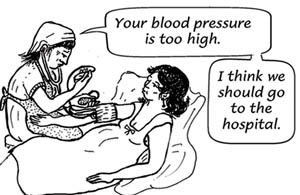
A major purpose of your antenatal care service is to make pregnant women aware of the danger symptoms of hypertensive disorders, to check their blood pressure at every antenatal visit (you learned how to do this in Study Session 9), and to make a timely diagnosis of hypertension and refer affected women as early as possible.
In this study session you will learn about the changes in the woman’s body as a result of hypertension and how this affects the mother and the fetus, the classifications of hypertension, the common risk factors for developing it, how to diagnose the different types and what actions to take in order to prevent worsening complications and even death.
In this study session you will learn about the main causes of early pregnancy bleeding, that is when a woman bleeds while pregnant and before 28 weeks, which should not happen normally. Abortion is one of the most common causes of early pregnancy bleeding and is an important cause of maternal mortality and morbidity globally. In addition, about 15 out of 100 pregnancies end in spontaneous abortion (miscarriage). You will learn how to classify abortions so you can give appropriate care, and about the legal aspects of abortion in Ethiopia and safe methods of abortion used in health facilities. Ectopic and molar pregnancies are the other main causes of early pregnancy bleeding. A woman can have serious health problems when a pregnancy ends early, so you need to know about the warning signs. The session ends with guidance on pre-referral emergency care that could save a woman’s life, and post-abortion counselling and family planning, which are important aspects of your role.
 Course Duration: 72 hours.